

Press release vs. news story: What’s the difference?

I went from receiving dozens of press releases in my inbox each week, hoping one might help to support my next “breaking” story, to being on the other side of that process. That meant sending what I believe was newsworthy to numerous reporters, hoping they think it is worth their time.
Back then as a reporter, my editor was on my back, pushing me to make sure our newsroom was the first to publish a bombshell report. As a freelancer in PR, I also remember the feeling of hoping a reporter or editor would spot a news story angle in a media pitch or a press release emailed to them.
Both perspectives have given me a closer look at why these two important forms of communication are often confused.
You hear these terms all the time in the news business and communications industry: a press release and a news story or article. What’s the difference? Aren’t they the same?
Press releases and news stories may look similar, but they serve different purposes. In this guide, you’ll learn the difference, where they overlap and how understanding both can help you pitch smarter and improve your chances of getting noticed.
This piece is based not only on my personal experience covering a variety of beats for both print and digital publications, but also on the extensive experience of our executives at Newsmatics, the parent company of EIN Presswire.
From the early days of distributing press releases from an office in Prague, Czechia, our executives have been in the news business for over three decades, bringing that experience and industry knowledge to the EIN Presswire team.
Therefore, I am happy to break down these important topics with the help of other PR experts and my colleagues at EIN Presswire, a press release service that distributes more than 3,000 releases each week to a global customer base.
The PR distribution platform helps people get their news in front of audiences through reputable news outlets.
What’s the difference between a press release, news story and article?
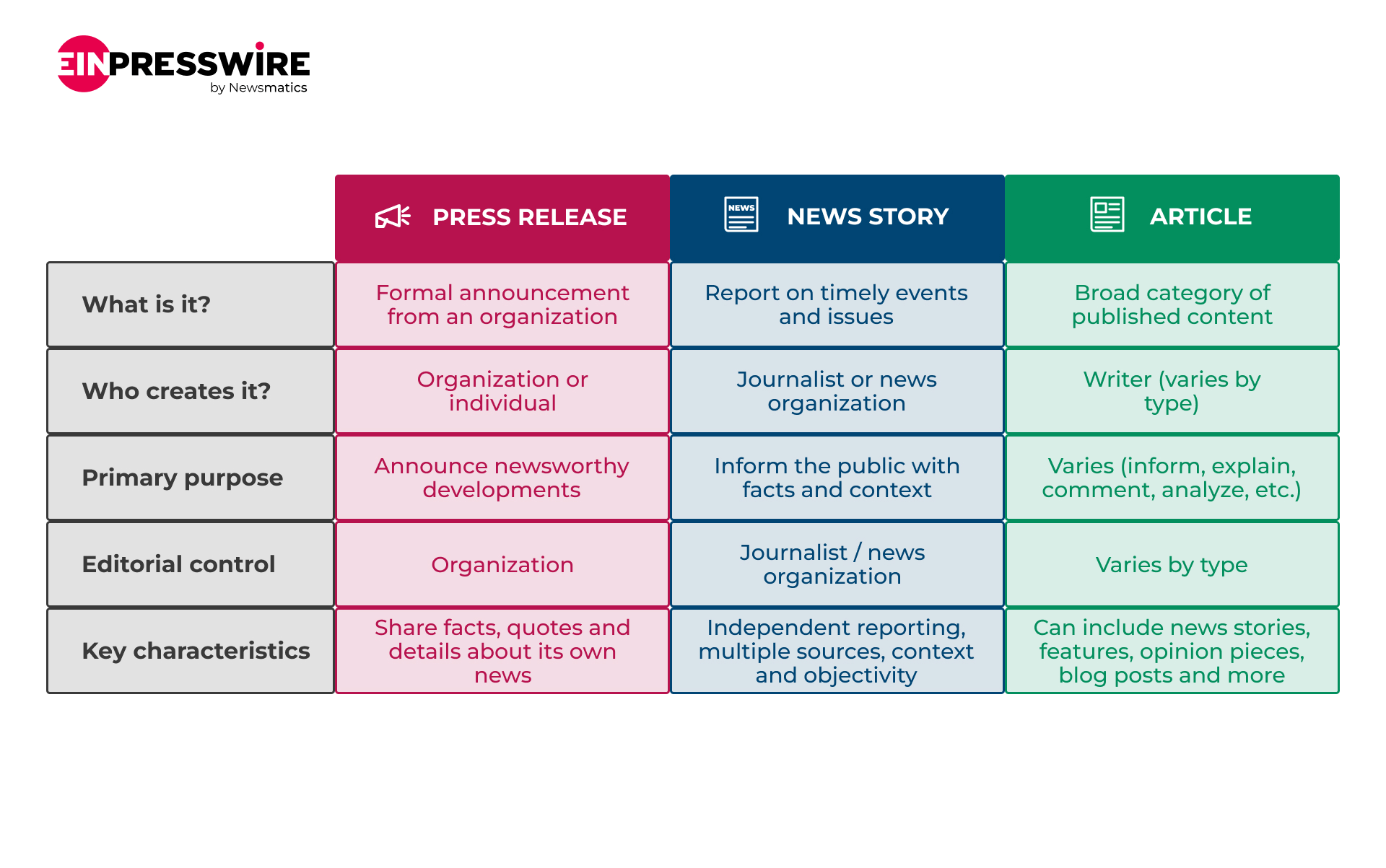
It’s true that both news stories and press releases share many of the same elements, but they serve different purposes and have distinct characteristics. Interestingly, they complement each other.
In traditional journalism, a news story is a written or video report that focuses on timely, fact-based information about current events and other topics deemed newsworthy by journalists.
During my journalism training, including multiple fellowships with the National Press Foundation, we honed our reporting skills by gathering facts, verifying information and giving audiences the context they need for an unbiased news story.
A press release, on the other hand, is issued by a company, organization or individual often as a formal announcement intended to inform the public and the media about what they deem as newsworthy developments or upcoming events.
Most communications professionals agree that press releases should typically range between 400 and 800 words.
Evan Kropp, executive director of Distance Education at the University of Florida College of Journalism and Communications and a faculty member in the online Master of Arts in Mass Communication program, described a release as “an organization’s account of its own news.”
“A press release is an organization speaking about itself,” Kropp added. “A news story is an independent journalist examining what happened, why it matters, and what the audience needs to know.”
As for press releases, Kropp said a strong press release provides journalists with several important elements:
The journalist then evaluates the claims, conducts additional reporting and places the information within a broader context, according to Kropp.
Meanwhile, an article is simply a broad term that includes news stories. But it also includes in-depth feature stories, commentaries, opinion pieces, and analysis that aren’t limited to reporting the news.
“An article is best understood as a general category of published content,” Kropp said, adding that articles can include profiles, explainers, commentary and other forms of written work.
“A press release may also be described informally as an article once it appears online, but its origin, purpose and editorial process remain different,” he added.
Where press releases fit into the news cycle
A press release, sometimes referred to as a news release, has a clear purpose.
As the name implies, it’s a written document intended to attract the attention of the press, including journalists and media outlets. It informs the public about newsworthy developments.
Sherrie Handrinos, CEO of Boost 1 Marketing, explained that she writes a release to announce a client’s product launch, expansion or company announcement, and sends it to journalists, editors, publishers and other media professionals.
“A press release is something that I write about them, their current efforts,” said Handrinos, who has helped clients secure media coverage in outlets including CNN, ESPN, and FOX Business. “That is sent to a specific press list in hopes of them feeling this as a relevant story to curate in their own words and report, interview or write something about.”
Almost every industry utilizes press releases for company announcements as well as new reports, book and music releases, and more.
I can recall receiving dozens of pitches a week through email as a former reporter, often in the form of a press release. And still to this day, I continue to receive pitches.
One thing press releases and written news stories often have in common is their adherence to what we call in the journalism world the inverted pyramid style.
It places the most important information first, followed by supporting details in descending order of importance. Along the way, it answers the five Ws:
Who. What. When. Where. Why.
However, while a press release can follow many of the same journalistic principles as a news story, it does not replace the reporting process behind one.
“A press release can provide the raw material for journalism, but it is not a substitute for journalism,” Kropp said. ”The reporter’s role is to verify the information, ask additional questions, seek other voices, and determine whether the announcement is genuinely newsworthy.”
Legal Disclaimer:
EIN Presswire provides this news content "as is" without warranty of any kind. We do not accept any responsibility or liability for the accuracy, content, images, videos, licenses, completeness, legality, or reliability of the information contained in this article. If you have any complaints or copyright issues related to this article, kindly contact the author above.
